A scalpel and an axe: I read the Posse Comitatus Act decision against Trump so you don’t have to

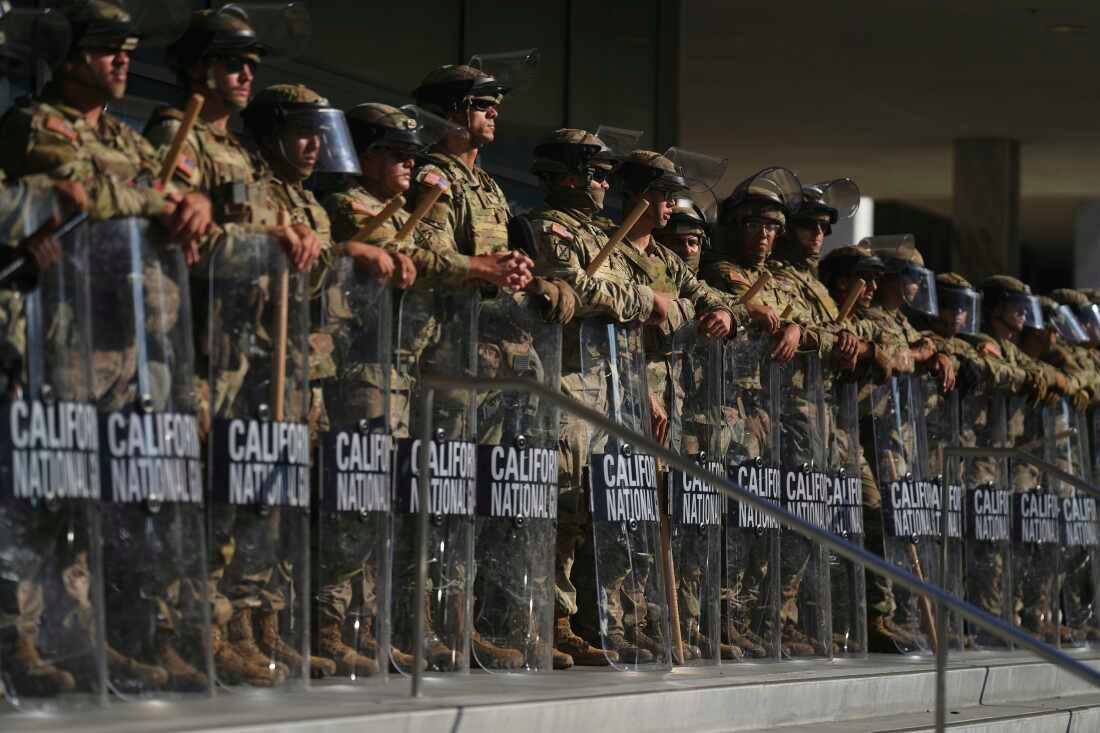
All we had to see were photographs of D.C. National Guard soldiers picking up trash and raking mulch to understand that Donald Trump had no real interest in “solving crime” in Washington D.C., his stated purpose for deploying uniformed, armed soldiers there. Stephen Miller is certainly happy that there are armed troops present when his ICE Nazis round up undocumented migrants at Home Depot but using the National Guard to “solve immigration” isn’t Trump’s purpose, either.
As he usually does, Trump has stated out loud why he wants to use the National Guard: to intimidate blue cities in blue states because they voted against him. He’s not deploying the Guard in Louisiana, which has a rate of violent crime four times that of California, or in Mississippi, where crime is even worse. He says he wants to scare Chicago next by stationing armed soldiers in full combat gear on street corners around the “Windy City.”
What is there to stop him? During his recent kiss-my-ass-or-you’re-out cabinet meeting, Trump declared to his assembled slobberers that if he wants to send National Guard troops to Chicago, “I have the right to do anything I want to do. I’m the President of the United States. If I think our country is in danger, and it is in danger in these cities, I can do it.” Today, Trump continued his process of attempting to terrorize Democrats when he announced that he will indeed send troops to Chicago, and Baltimore to boot.
Governor Gavin Newsom, who has been having a pretty good time trolling Trump over the last couple of weeks, filed a lawsuit challenging Trump’s L.A. deployment. Today U.S. District Judge Charles R. Breyer issued his decision on Newsome’s lawsuit, ruling that Trump’s deployment of the National Guard and Marines in Los Angeles was illegal because he had violated the Posse Comitatus Act (PCA). Breyer, the brother of former Supreme Court Justice Stephen Breyer, enjoined Trump and Secretary of Defense Pete Hegseth from violating the PCA in California in the future. Breyer said that Trump and Hegseth intend “to call National Guard troops into federal service in other cities across the country—including Oakland and San Francisco, here in the Northern District of California—thus creating a national police force with the President as its chief.”
Breyer wrote that “defendants instigated a months-long deployment of the National Guard and Marines to Los Angeles for the purpose of establishing a military presence there and enforcing federal law. Such conduct is a serious violation of the Posse Comitatus Act. These violations were part of a top-down, systemic effort by Defendants to use military troops to execute various sectors of federal law (the drug laws and the immigration laws at least) across hundreds of miles and over the course of several months—and counting.”
Breyer held that Trump’s orders violated the PCA in multiple ways: Trump specifically directed the commander of the deployment to use the soldiers for law enforcement purposes, an action banned by the PCA; failed to insist that the military forces coordinate with local law enforcement; and used an inadequate rationale to justify a military deployment for civilian law enforcement purposes.
The deployment of some 4,000 troops to L.A. was part of an apparent conspiracy to break the law. The National Guard and Marine task force was given training in which law enforcement activities were banned by the PCA, including “security patrols,” “traffic control” and “crowd control.” Federal law enforcement agencies such as the DEA and ICE were then given orders on how to get around those proscriptions when requesting assistance from the military by substituting the words that changed the purposes of the military deployment from “security” to “protection.” An email that went out to all federal law enforcement commanders emphasized that “If the requested activity cannot be converted to a ‘protection’ term, then we cannot perform it.”
National Guard troops and Marines deployed to Los Angeles were used in support of federal law enforcement at least 64 times, Breyer wrote, sometimes sent to Ventura, Riverside, and Santa Barbara counties more than 100 miles outside of Los Angeles to backup federal raids on marijuana farms. Local law enforcement officials in the distant counties were given only two hours’ notice that federal law enforcement raids were going to take place, and they were not informed at all that National Guard and Marines would be assisting.
Judge Breyer went into detail in his opinion about how the camouflage uniforms worn by the military are so close in appearance to the camouflage outfits worn by DEA and ICE agents that they were indistinguishable to local law enforcement officers and civilians alike. Breyer wrote that Trump’s orders “systematically used armed soldiers (whose identity was often obscured by protective armor) and military vehicles to set up protective perimeters and traffic blockades, engage in crowd control and otherwise demonstrate a military presence in and around Los Angeles.” The duties soldiers were ordered to carry out were rightfully the job of civilian law enforcement, Breyer said.
Trump decided not to invoke the Insurrection Act to justify the deployment of military forces in California. That left him with trying to explain use of armed soldiers to aid law enforcement as an exception to the Posse Comitatus Act by invoking “10 U.S.C. § 12406(3), which provides that the President can do so “[w]henever … the President is unable with the regular forces to execute the laws of the United States.”
Breyer carefully pointed out how that under such a broad interpretation of the law, Trump could use the National Guard to enforce the laws against tax shelters. If citizens and corporations were using shelters to avoid paying taxes, Trump could claim “he is unable to execute the tax laws.” If the EPA was unable to trace pollution back to a specific manufacturing plant, Trump “could claim that he is unable to execute the Clean Water Act.”
Breyer held that Trump’s assertion of presidential powers in exception to the law “would place no meaningful guardrails on the federalization and use of National Guard troops and would thereby render the Insurrection Act redundant.”
Breyer wielded his axe when he called out Trump for having “deployed the National Guard and Marines to Los Angeles, ostensibly to quell a rebellion and ensure that federal immigration law was enforced. There were indeed protests in Los Angeles, and some individuals engaged in violence. Yet there was no rebellion, nor was civilian law enforcement unable to respond to the protests and enforce the law.”
There was no rebellion in Washington D.C for Trump to quell. There is no rebellion in Chicago or Baltimore or San Francisco or Oakland, all cities that Trump has threatened with military takeover. Breyer’s reference to “guardrails” seems rather quaint at this point, but he forcefully ruled that Trump broke the law and used an entirely fake rationale to justify his deployment of the military to Los Angeles and intends to do the same thing to other cities controlled by Democrats.
The judiciary is doing its part to hold up the rule of law. If we don’t want soldiers walking around in combat gear carrying automatic rifles in cities from Washington to San Francisco, the next move is up to us.
Governor Newsom. I added an "e" for some unknown reason...probably fatigue.
Ridiculous how this fucking dictator attempts to quell non-existent rebellions when he himself fomented the J6 insurrection. And pardoned the violent assholes who perpetrated it and assaulted, injured, and caused the death of law enforcement officers.